It always happens at the worst time. You are vacuuming the living room while the kettle is on and suddenly the lights go out. You are left standing in the dark wondering why your electrical system decided to quit. While a tripping breaker is a massive inconvenience, it is actually doing its job. It is a safety switch designed to protect your home from electrical fires and melted wiring.
In Vancouver, many older homes in Kitsilano or East Van were built for a time when “high tech” meant a toaster and a radio. Today, we have air fryers, gaming PCs, and EV chargers all pulling from the same old wires. Understanding the root cause of the shutoff can save you money on unnecessary repairs and keep your family safe.
1. The Most Likely Culprit: Circuit Overload
The most common answer to why does my breaker trip? is simply that you are asking for more power than the circuit can give. Every circuit has a limit, usually 15 or 20 amps. When you exceed that limit, the internal mechanism heats up and flips the switch to “off” to prevent the wires from catching fire.
Think of your electrical system like a series of water pipes. If you try to force ten gallons of water through a pipe meant for two, something is going to burst. In your home, the breaker trips before the “burst” happens. This often occurs in kitchens where high-wattage appliances like microwaves and coffee makers share a single circuit.
2. Resetting a Breaker Safely
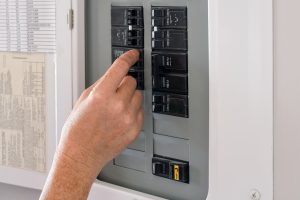
Before you can fix the problem, you need to restore power. However, many homeowners do this incorrectly or feel nervous about touching the metal panel. Resetting a breaker safely starts with turning off or unplugging the devices that caused the trip in the first place.
Once the load is removed, open your panel door. Look for the switch that isn’t lined up with the others. It will usually be stuck in a middle position or moved all the way to “Off.” To reset it, you must first push the switch firmly to the “Off” position until you hear a click. Only then should you flip it back to the “On” position. If you just try to push it to “On” from the middle position, it won’t engage.
If you want to understand the physical parts inside that box before you touch it, checking the anatomy of an electrical panel can give you a better idea of how these safety levers function.
3. The Danger Zone: Short Circuits
A short circuit is more serious than a simple overload. This happens when a “hot” wire (carrying electricity) touches a “neutral” wire. This creates a sudden, massive spike in current that forces the breaker to trip instantly.
How do you know if you have a short circuit? If you reset the breaker and it pops back to the off position immediately with a loud “pop” or a spark, do not try to reset it again. This indicates a physical fault in the wiring or a failed appliance. Short circuits are often caused by loose connections, damaged wire insulation, or even rodents chewing on wires behind your walls.
4. Ground Faults and Moisture
A ground fault is a specific type of short circuit. It happens when the hot wire touches the ground wire or a grounded part of a junction box. This is very common in bathrooms, kitchens, and outdoor outlets where moisture is present.
Water is an excellent conductor of electricity. If moisture gets into an outlet, it can create a path for electricity to “leak” out of the wires. This is why Canadian building codes require GFCI (Ground Fault Circuit Interrupter) outlets near any water source. These outlets are even more sensitive than your main breaker and will shut off power in milliseconds to prevent a lethal shock.
5. Arc Faults and Aging Wiring
If you live in a classic Vancouver character home, your wiring might be decades old. Over time, wires can become brittle. An “arc fault” happens when electricity jumps (or arcs) between loose connections or damaged wires. This creates intense heat but might not always pull enough amps to trip an older style breaker immediately.
Modern homes use AFCI (Arc Fault Circuit Interrupter) breakers to detect this specific sparking. If your breakers are tripping and you can’t find a clear reason like an overloaded outlet, it could be a sign that your wiring is failing behind the scenes. This is a primary reason to consider service panel upgrades to ensure your home meets modern safety standards.
When to Stop Troubleshooting and Call a Pro
We understand the desire to save money by fixing things yourself. However, electricity is unforgiving. If you notice any of the following symptoms, stop what you are doing and contact an electrician immediately:
- Burning Smells: A scent of ozone or burning plastic near the panel or an outlet.
- Discolouration: Brown or black scorch marks on an outlet or the breaker itself.
- Heat: The breaker or the wall around an outlet feels hot to the touch.
- Humming or Buzzing: Any audible noise coming from your electrical panel.
- Frequent Tripping: If the same breaker trips more than once a month without a clear overload.
The Hidden Cost of Ignoring a Tripping Breaker
Many homeowners ignore a tripping breaker by simply using an extension cord to plug their appliance into a different room. This is a temporary fix that creates a long-term hazard. Extension cords are not meant for permanent use and can overheat, leading to fires.
Ignoring the problem can also lead to “weakened” breakers. Every time a breaker trips, the mechanical components inside experience wear. Eventually, the breaker may fail to trip at all, or it may trip constantly even when there is no load. Replacing a single breaker is an affordable repair. Replacing a whole home’s worth of fire-damaged belongings is not.

Upgrading for the Future
If your Vancouver home still has a 60-amp or 100-amp panel, you are likely pushing your system to its limit every single day. Modern homes generally require a 200-amp service to handle heat pumps, EV chargers, and high-end kitchen appliances comfortably.
Upgrading your panel isn’t just about stopping the annoyance of a tripping breaker; it’s about increasing your home’s value and ensuring you are ready for the transition to greener energy. A stable electrical system provides peace of mind that your home can handle the Canadian winter without the lights flickering every time the heater kicks in.
Stop the Tripping and Secure Your Peace of Mind
A tripping breaker is more than just a nuisance—it is your home’s way of sounding an alarm. Whether you are dealing with an aging electrical panel in a heritage home or simply need more power for your modern appliances, you don’t have to guess at the solution.
At TDR Electric, our Red Seal certified electricians specialize in diagnosing complex wiring issues and performing seamless service panel upgrades for homeowners across Vancouver and the Lower Mainland. We provide transparent pricing and expert safety inspections so you can stop running to the basement every time you turn on the kettle.
Ready to fix your power for good? Contact TDR Electric Today to schedule your residential electrical inspection or call us at (604) 987-4122. Let’s make sure your home’s electrical system is safe, reliable, and ready for the future.
FAQs
Is it dangerous if my breaker trips once? Not necessarily. It usually means the safety system worked as intended to stop an overload. However, if it happens repeatedly, it indicates an underlying issue that needs an inspection.
Why does my breaker trip when I turn on the vacuum? Vacuums have powerful motors that require a “surge” of electricity to start. If the circuit is already running a TV, lights, or a computer, that extra surge pushes the total amperage over the limit.
Can a bad appliance cause a breaker to trip? Yes. If an appliance has an internal short circuit or a frayed cord, it will trip the breaker the moment it is plugged in or turned on. Try testing the circuit with a different device to see if the problem follows the appliance.
How much does it cost to fix a tripping breaker? If it is just a matter of replacing a faulty breaker, the cost is relatively low. If the issue is deep-seated wiring damage or an overloaded panel, costs will vary based on the scale of the upgrade needed.
Why does my breaker trip even when nothing is plugged in? This is a strong sign of a short circuit in the permanent wiring or a failed breaker. You should keep that breaker off and call a professional to trace the fault.