Kitchen renovations in the Lower Mainland are changing. More homeowners are swapping out old gas ranges for sleek, high-efficiency induction technology. It makes sense because induction is faster, easier to clean, and better for indoor air quality. However, many people get halfway through their remodel before realizing their home’s electrical “backbone” cannot handle the new appliance.
The “surprise expense” of an electrical upgrade is a common headache during renovations. You pick out a beautiful $4,000 cooktop only to find out that installing it requires another $5,000 in panel work. Understanding induction cooktop electrical requirements early in the design phase is the best way to keep your budget on track and your home safe.
The Power Demand of Modern Cooking
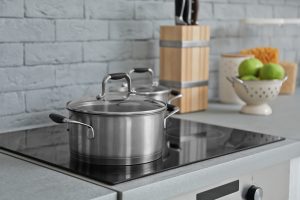
Induction cooking works through magnetic induction rather than thermal conduction. This means it uses powerful electromagnets to heat your pans directly. While this is incredibly efficient, it requires a massive “gulp” of electricity when you have multiple burners going at once.
Most traditional electric stoves operate on a 30-amp or 40-amp circuit. Many high-performance induction cooktops from brands like Wolf, Miele, or Bosch specifically call for a 50-amp breaker. If your home has a standard 100-amp electrical panel, that single cooktop could potentially use half of your home’s total available power.
Why Your Panel Might Not Be Ready
Vancouver is full of beautiful character homes and mid-century bungalows. Many of these properties were built when the biggest electrical draw was a refrigerator and a few light bulbs. If you are still running on a 100-amp service, adding an induction cooktop is often the “tipping point” that necessitates service panel upgrades.
It is not just about the number of breakers in the box. It is about the total load calculation. When an electrician looks at your home, they have to account for your dryer, your water heater, and your dishwasher. Adding a 50-amp cooktop to a 100-amp panel often violates the Canadian Electrical Code because the total potential demand exceeds the safe limit of the main breaker.
The Strata Roadblock: Challenges for Condo Owners
If you live in a condo or townhouse in Downtown Vancouver or North Vancouver, your challenges are slightly different. You aren’t just limited by your own panel; you are limited by the building’s infrastructure. Strata buildings have a set amount of power allocated to each unit.
Before you commit to a purchase, you must verify the building’s capacity. Some older concrete high-rises simply do not have the “headroom” to allow every resident to switch to high-draw electric appliances. Getting an early assessment from a professional can save you from a dispute with your strata council later.
Understanding the Electrical Permit for Kitchen Remodel Projects
In British Columbia, any significant electrical change requires a permit. This includes running a new dedicated line for a cooktop. Securing an electrical permit for kitchen remodel work is not just a bureaucratic step; it is your proof of safety.
A permit ensures that a Technical Safety BC inspector (or a municipal inspector) reviews the work. They check that the wire gauge is correct for the amperage and that the panel can handle the load. This is vital for your home insurance. If a fire occurs and it is traced back to unpermitted electrical work, your claim could be denied.
Safety Anxiety: Wiring and Wire Gauge
We often see homeowners who want to “just swap” their old electric stove for induction. Unfortunately, the old wiring might not be thick enough. A 50-amp circuit requires 6-gauge copper wire. If your previous stove used 8-gauge or 10-gauge wire, the thinner wire will overheat under the pressure of an induction unit.
Overheated wires lead to melted insulation and, eventually, electrical fires. Professional installation ensures that the wiring from the panel to the kitchen matches the manufacturer’s specifications. Safety is the priority, and modern induction units are very sensitive to voltage drops caused by undersized wiring.
The Road to Electrification in Canada
The shift toward induction is part of a much larger movement. Many Canadians are looking for ways to reduce gas usage and move toward a fully electric lifestyle. This transition often involves a series of upgrades, starting with the kitchen and moving to the garage.
As noted in this account of saving money and electrifying our home in Canada, the process is a long-term investment. By upgrading your panel for a cooktop now, you are also preparing your home for a future EV charger or a high-efficiency heat pump. It is better to do one major panel upgrade now than to pay for three small electrical changes over the next five years.
Load Calculations: The Professional Secret
When you contact an electrician, the first thing they should do is a “demand load calculation.” This is a mathematical formula that looks at the square footage of your home and the specific wattage of all your fixed appliances.
This calculation tells us exactly how many amps you are currently using and how much room is left. If the math says you are at 95% capacity, adding an induction cooktop will cause your main breaker to trip constantly. It is better to know this before the kitchen cabinets are installed and the backsplash is tiled.
Why You Shouldn’t DIY an Induction Install
It can be tempting to try and save money by running the wire yourself. However, induction units require a 240-volt connection. This involves working with two “hot” legs of electricity. A mistake here doesn’t just result in a broken appliance; it can result in a fatal shock.
Furthermore, many high-end appliance warranties are only valid if the unit is installed by a licensed professional. If you fry the control board of a $5,000 cooktop because it was wired incorrectly, the manufacturer will likely refuse to cover the repair.
Future-Proofing Your Investment
A kitchen renovation is one of the biggest investments you will make in your home. It is easy to get caught up in the aesthetics—the quartz counters, the shaker cabinets, and the gold hardware. But the most important part of the kitchen is the part you can’t see: the power behind the walls.
Upgrading to a 200-amp service provides the freedom to grow. You won’t have to worry about whether the lights will flicker when the oven turns on. You won’t have to choose between cooking dinner and charging your car. A robust electrical system is the foundation of a modern, functional home.

Don’t Let a Surprise Expense Stall Your Dream Kitchen
There is nothing worse than having your high-end induction cooktop arrive only to realize your home can’t power it. Whether you are in a detached house in Kitsilano or a condo in North Vancouver, knowing your induction cooktop electrical requirements before you buy is the key to a stress-free renovation.
At TDR Electric, we help Lower Mainland homeowners bridge the gap between beautiful design and safe electrical infrastructure. Our Red Seal certified team can perform a precise load calculation and handle your service panel upgrades to ensure your kitchen is ready for the future of cooking.
Planning a kitchen remodel? Contact TDR Electric today for a professional consultation, or call us at (604) 987-4122. Let’s make sure your renovation is powered correctly from day one.
FAQs
Can I run an induction cooktop on a 30-amp circuit? Some smaller or “portable” induction hobs can run on 30 amps or even a standard 15-amp outlet. However, full-sized residential induction ranges usually require 40 or 50 amps to operate all burners at full power simultaneously.
What happens if I don’t upgrade my panel? If your panel is overloaded, your main breaker will trip. This shuts down power to the entire house. Repeatedly overloading a panel can also cause heat damage to the bus bars, leading to a much more expensive emergency repair later.
How do I know my current panel’s amperage? Look at your main breaker, which is usually at the very top or bottom of your electrical panel. It will have a number stamped on the handle, such as 100, 125, 150, or 200. This is your home’s total capacity.
Does induction cooking require special pans? Yes, induction requires magnetic cookware. If a magnet sticks to the bottom of your pan, it will work. While this is an extra cost, it is separate from the electrical infrastructure needs.
Is an induction cooktop more expensive to run? Induction is actually more energy-efficient than traditional electric coils or gas. Because it heats the pan directly, less heat escapes into the kitchen, meaning your BC Hydro bill might actually see a slight benefit over time.